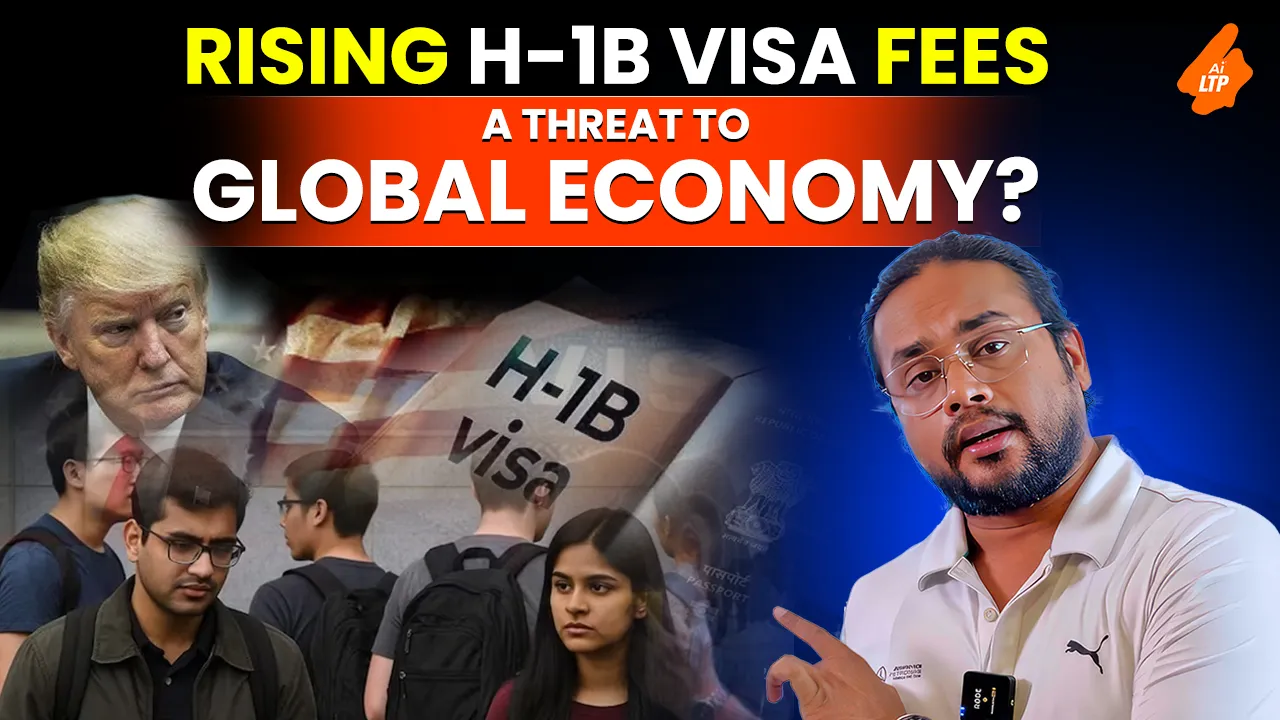

How Rising H-1B Visa Fees Could Push the World Towards a Recession
The H-1B visa in the United States is not just a lifeline for Indian professionals but also the backbone of the global technology and research industry. When the world’s biggest companies — Meta, Microsoft, Amazon, Google — hire millions of foreign professionals through this visa, any sharp policy change impacts not just America but the global economy.
1. Billions of Dollars in Extra Burden on US Companies
• Every year, around 85,000 new H-1B visas are issued in the US.
• Currently, there are nearly 600,000–700,000 H-1B employees working in America.
• If each employee costs an extra $100,000 annually, the total additional burden will be:
700,000 × $100,000 = $700 billion (≈ ₹58 lakh crore) per year
👉 To put this in perspective, this amount is nearly equal to the entire US defense budget (around $816 billion).
2. Impact on Jobs in the Tech Sector
• The US tech industry contributes about 10% of the country’s GDP.
• If companies try to reduce this massive cost, they will freeze hiring or cut jobs.
• According to Layoffs.fyi, more than 500,000 tech employees were already laid off in 2022–2023. A sharp H-1B fee hike could potentially double this figure in the next few years.
3. Shockwaves in India and Asia
• India’s IT exports to the US alone are worth over $150 billion annually.
• If US companies reduce their dependence on H-1B employees, Indian IT giants like Infosys, TCS, and Wipro may see contracts shrink.
• According to NASSCOM, India’s IT industry employs nearly 5 million people. Even small disruptions in outsourcing could ripple through India’s GDP and employment levels.
4. Brake on Innovation and Startups
• The US spends nearly $700 billion annually on R&D, with a huge contribution from immigrant engineers and scientists.
• Reduced inflow of H-1B talent would slow the growth of cutting-edge fields like artificial intelligence, machine learning, and quantum computing.
• This would weaken the startup ecosystem globally, as fewer innovations mean fewer new business opportunities.
5. Domino Effect on the Global Economy
• US companies cut costs → Jobs are reduced.
• Job losses → Consumer spending drops (fewer people buy houses, cars, or gadgets).
• Reduced consumption → Manufacturing and services take a hit.
• This domino chain could affect trade, investments, and growth worldwide.
Conclusion
In simple words, if H-1B fees are raised to $100,000 per employee per year, then:
• US companies face a $700 billion annual burden,
• Millions of tech jobs could be at risk,
• India’s $150 billion IT export sector would be hit,
• Global innovation and investment would slow down.
👉 This cascading impact could gradually push the world toward a recession-like scenario.
📌 Useful Links
• USCIS – H-1B Visa Policy: https://www.uscis.gov
• NASSCOM IT Industry Report: https://nasscom.in
• World Bank – Global Economic Outlook: https://www.worldbank.org
• Open your mutual funds account on below link & get your funds suggested by Dr. Vinay Prakash Tiwari: http://p.njw.bz/44600
• Open your demat account in Punch: https://punn.ch/ltp-on-punch
• Open a free demat account with Zerodha and start investing in stocks, derivatives, mutual funds, ETFs, bonds, IPOs, and more: https://zerodha.com/open-account?c=ZMPGFJ
Written by Dr. Vinay Prakash Tiwari, Founder – LTP Calculator Financial Technology Pvt. Ltd & Daddy’s International School & Hostel, Bishunpura Kanta, Chandauli, UP
