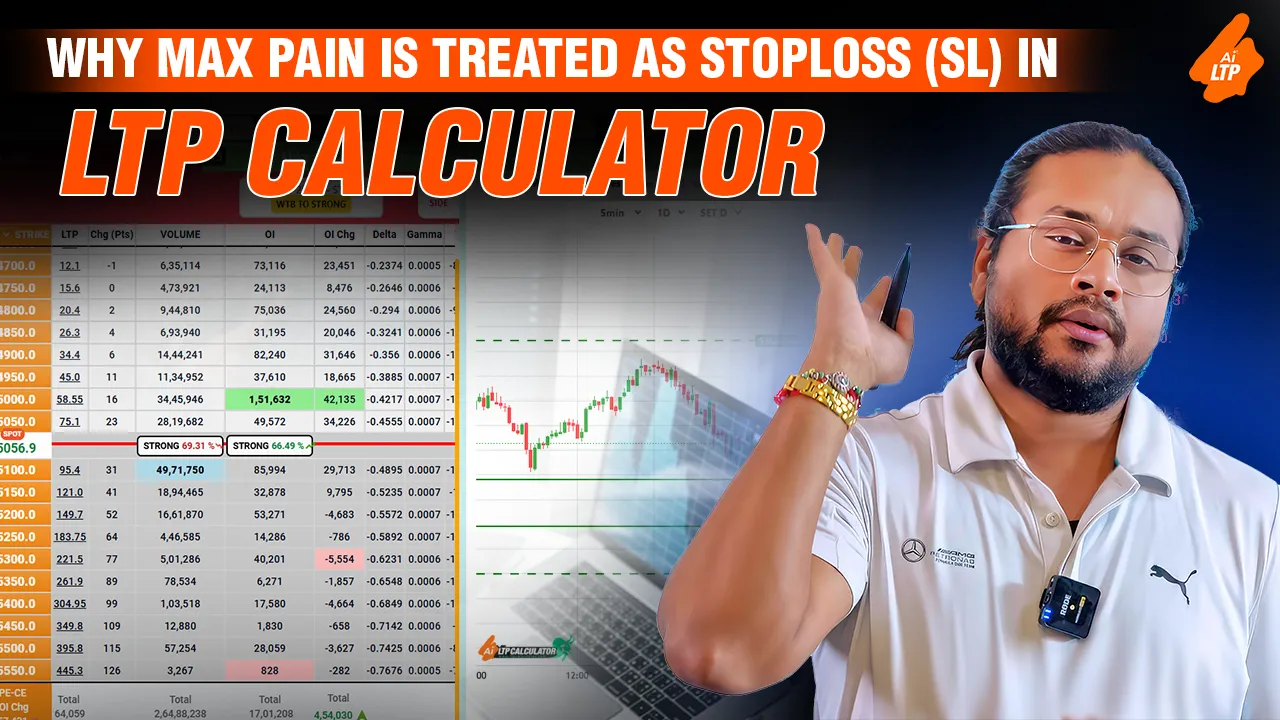

Why Max Pain Is Treated as Stop Loss (SL) in LTP Calculator
Most traders consider Max Pain as the “expiry magnet” — the level where prices tend to settle.
But inside the LTP Calculator, developed under Dr. Vinay Prakash Tiwari’s Reversal Price Theory, Max Pain is not a target — it’s a Stop Loss (SL).
This change in perspective is what makes the LTP Calculator’s accuracy so unique compared to traditional option-chain tools.
1️⃣ The Traditional Meaning of Max Pain
In normal market studies, Max Pain means the strike price where the most option buyers will lose money and option sellers gain the maximum.
So, traders assume that the market will expire near that Max Pain level.
However, this traditional view assumes that the market will remain stable and option writers are in full control — which doesn’t always happen, especially during volatile intraday movements.
2️⃣ The LTP Calculator Perspective
In LTP Calculator, Max Pain acts as a defensive level, not a predictive one.
When the price approaches the Max Pain level, it often represents an area of exhaustion where the market may either pause or reverse.
Hence, the algorithm treats Max Pain as the Stop Loss (SL) —
meaning, once the price moves beyond Max Pain, the probability of trend continuation is higher, and the previous trend view becomes invalid.
3️⃣ Why Max Pain Works as a Stop Loss
• Max Pain is the comfort zone of option sellers.
• When price moves sharply away from it, sellers begin to hedge or exit their positions.
• This sudden change in their position causes a spike in volatility and volume, confirming a new directional move.
That’s why LTP Calculator algorithms automatically shift the trade bias once price breaks the Max Pain zone.
4️⃣ Example
If NIFTY’s Max Pain is 22,200
and the LTP Calculator shows a Bullish Reversal from 22,050,
then 22,200 becomes your Stop Loss (SL) — not your target.
But if it reverses and closes below Max Pain, the bullish setup is invalidated.
5️⃣ How LTP Calculator Uses Max Pain in Reversal Analysis
• In Bullish Zones, Max Pain = SL below which reversal fails.
• In Bearish Zones, Max Pain = SL above which bearish trend fails.
• This aligns perfectly with EOR (Extension of Resistance) and EOS (Extension of Support) data, creating an AI-powered risk control mechanism.
That’s why professional traders using LTP Calculator don’t just find entries — they also find pre-calculated Stop Loss zones, derived from real-time option-chain behavior.
Key Takeaway
While the market sees Max Pain as a magnet,
LTP Calculator sees it as a line of risk control.
Once price crosses it, sentiment shifts, and your SL triggers automatically, ensuring you never overstay in a losing trade.
This is one of the core strengths of Dr. Vinay Prakash Tiwari’s Reversal Price Theory — turning data into discipline.
📌 Useful Links
• NSE India: https://www.nseindia.com
• BSE India: https://www.bseindia.com
• AMFI India: https://www.amfiindia.com
• Open your mutual funds account on below link & get your funds suggested by Dr. Vinay Prakash Tiwari: http://p.njw.bz/44600
• Open your demat account in Punch: https://punn.ch/ltp-on-punch
• Open a free demat account with Zerodha and start investing in stocks, derivatives, mutual funds, ETFs, bonds, IPOs, and more: https://zerodha.com/open-account?c=ZMPGFJ
Written by Dr. Vinay Prakash Tiwari, Founder – LTP Calculator Financial Technology Pvt. Ltd & Daddy’s International School & Hostel, Bishunpura Kanta, Chandauli, UP
⚠ Disclaimer: This blog is for educational purposes only. Option trading involves risk. LTP Calculator’s interpretations are based on proprietary algorithms of Reversal Price Theory and should be used with proper risk management and discipline.
