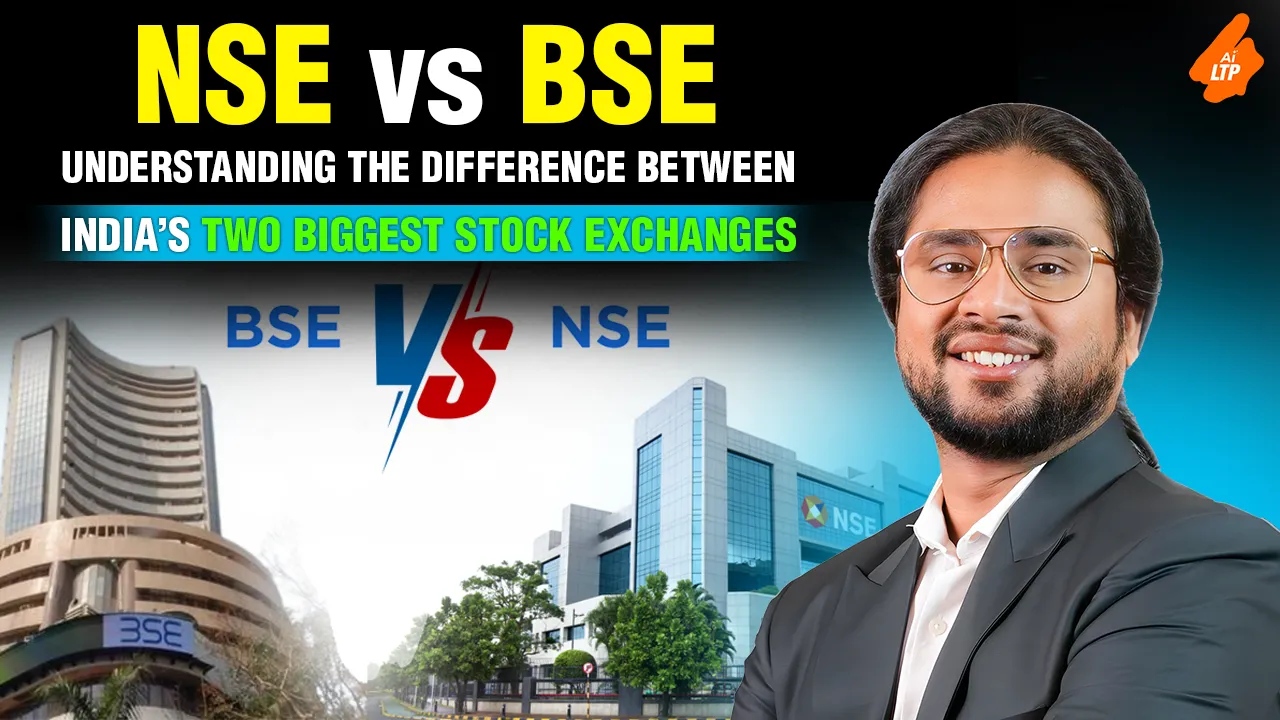

NSE vs BSE: Understanding the Difference Between India’s Two Biggest Stock Exchanges
When we talk about the Indian stock market, two names dominate every conversation — NSE (National Stock Exchange) and BSE (Bombay Stock Exchange).
Both are powerful institutions that drive India’s financial system, yet most beginners don’t clearly understand how they differ.
Let’s break down the story of NSE vs BSE — their origin, structure, technology, and the role each plays in shaping India’s trillion-dollar economy.
1. Origin and History
BSE (Bombay Stock Exchange) is Asia’s oldest stock exchange, established in 1875.
It started under a banyan tree in Mumbai’s Dalal Street, where brokers gathered to trade shares manually. Over the years, BSE became the symbol of India’s traditional financial heritage.
On the other hand, NSE (National Stock Exchange) was founded much later, in 1992, as India’s first fully electronic stock exchange.
It brought transparency, speed, and digital efficiency — marking a new era of modern, tech-driven trading.
2. Ownership and Structure
• BSE is managed by BSE Limited, a listed company itself (traded under the symbol BSE).
• NSE is operated by National Stock Exchange of India Ltd., which is not yet listed on any exchange.
This is why you can buy shares of BSE but not NSE — an irony many investors find interesting.
3. Technology and Trading Speed
NSE revolutionized Indian markets with fully automated electronic trading, allowing instant order matching and high transaction volume handling.
It introduced NEAT (National Exchange for Automated Trading), one of the world’s fastest trading systems.
BSE later upgraded its system to BOLT (BSE Online Trading), now capable of matching NSE’s speed — executing millions of orders in milliseconds.
Both exchanges now use tick-by-tick data, AI risk engines, and co-location servers to support algorithmic and high-frequency trading.
4. Index Comparison
Each exchange has its own benchmark index:
• BSE Sensex — tracks 30 large, established companies (the oldest index in India).
• NSE NIFTY 50 — tracks 50 diversified large-cap companies across sectors.
While both represent India’s market sentiment, NIFTY 50 is often considered more diversified and is used globally as India’s performance indicator.
5. Market Share and Volume
• NSE holds over 85–90% market share in equity derivatives and cash trading volume.
• BSE dominates in SME (Small and Medium Enterprises) listings and mutual fund platforms.
In simple terms:
NSE = higher liquidity and faster execution
BSE = heritage, depth, and broader listings
6. Settlement and Regulation
Both exchanges are regulated by SEBI (Securities and Exchange Board of India) and follow a T+1 settlement cycle (trade plus one day).
Clearing and settlement for NSE trades are handled by NSCCL, and for BSE trades by Indian Clearing Corporation Ltd. (ICCL).
7. Listing and IPOs
Companies can choose to list on either one or both exchanges.
However, most prefer dual listing (NSE + BSE) to attract a larger pool of investors and ensure liquidity.
8. Investor Experience
For most retail traders, the interface and experience feel similar because brokers offer integrated platforms that access both exchanges.
Still, NSE is generally preferred for trading, while BSE is often used for long-term holdings and smaller-cap stocks.
Key Takeaway
Both NSE and BSE are pillars of India’s economic growth.
If BSE is the heritage, NSE is the innovation.
Together, they ensure transparency, liquidity, and investor confidence in one of the world’s fastest-growing financial markets.
📌 Useful Links
• NSE India: https://www.nseindia.com
• BSE India: https://www.bseindia.com
• AMFI India: https://www.amfiindia.com
• Open your mutual funds account on below link & get your funds suggested by Dr. Vinay Prakash Tiwari: http://p.njw.bz/44600
• Open your demat account in Punch: https://punn.ch/ltp-on-punch
• Open a free demat account with Zerodha and start investing in stocks, derivatives, mutual funds, ETFs, bonds, IPOs, and more: https://zerodha.com/open-account?c=ZMPGFJ
Written by Dr. Vinay Prakash Tiwari, Founder – LTP Calculator Financial Technology Pvt. Ltd & Daddy’s International School & Hostel, Bishunpura Kanta, Chandauli, UP
⚠ Disclaimer: This blog is for educational purposes only. Trading and investing in financial markets involve risk. Data presented here is based on publicly available sources and may vary with time and market conditions.
