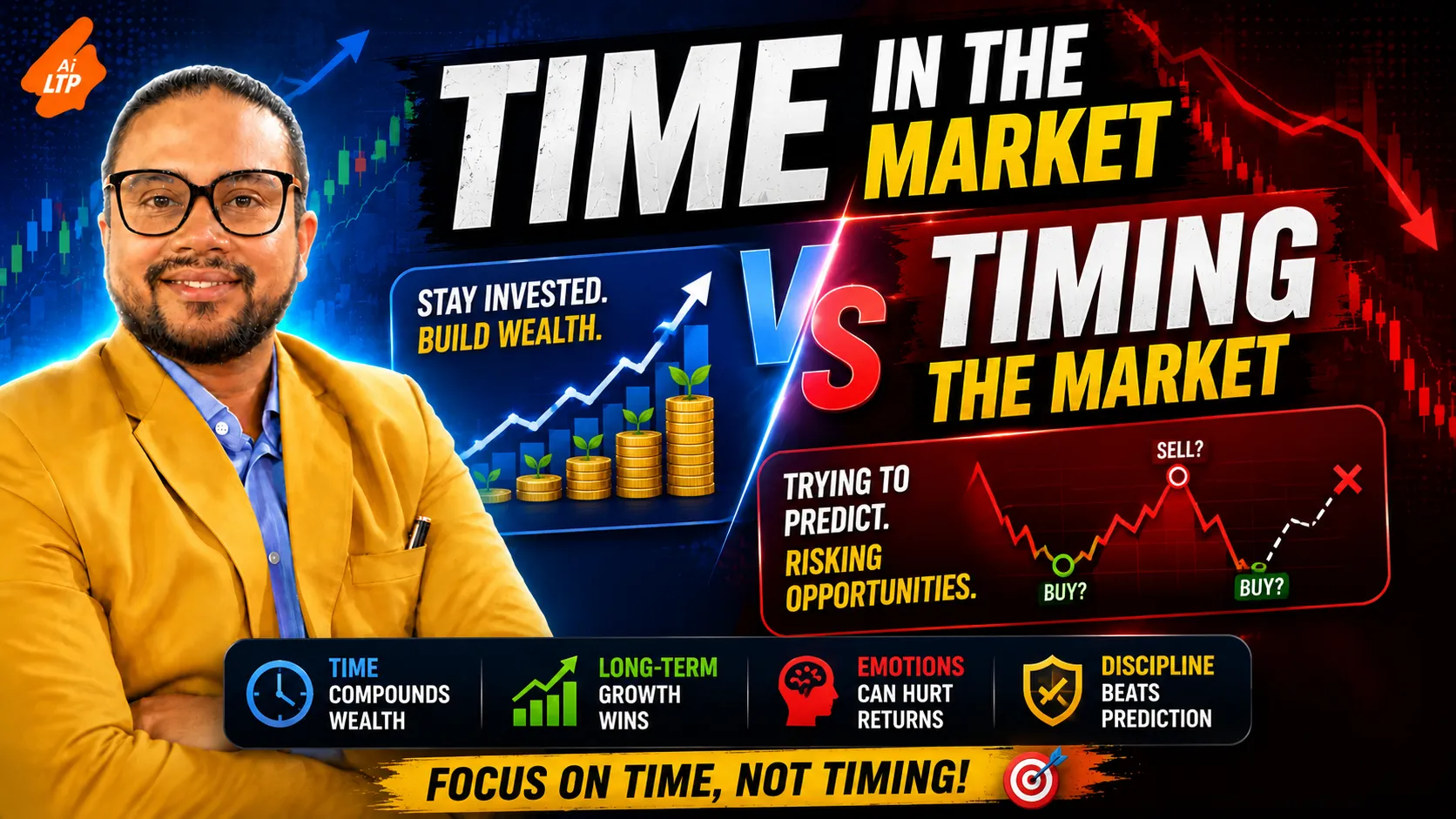

Time in the Market vs Timing the Market: Which Strategy Builds More Wealth?
Every investor dreams of buying stocks at the lowest price and selling them at the highest. It sounds simple in theory, but in reality, consistently predicting market tops and bottoms is one of the most difficult tasks in investing. This is why one of the oldest and most valuable lessons in the financial world is: Time in the Market is more important than Timing the Market.
The difference between these two approaches has determined the success or failure of countless investors. Understanding this concept can help you make better investment decisions and build wealth over the long term.
What Does "Timing the Market" Mean?
Timing the market means trying to predict when stock prices will rise or fall so that you can buy at the perfect moment and sell before prices decline.
Many investors attempt to:
- Buy after a market crash.
- Sell before a correction.
- Wait for "the right time" to invest.
- Exit investments during uncertainty.
Although this sounds attractive, even experienced fund managers and professional investors struggle to predict market movements consistently.
Markets react to countless factors such as:
- Economic data
- Interest rate changes
- Inflation
- Corporate earnings
- Global events
- Investor sentiment
Since no one can accurately forecast all these variables, market timing often becomes guesswork.
What Does "Time in the Market" Mean?
Time in the market focuses on staying invested for many years instead of trying to predict short-term price movements.
Rather than asking,
"When should I invest?"
Long-term investors ask,
"How long can I stay invested?"
This approach allows investments to benefit from:
- Compounding
- Business growth
- Economic expansion
- Dividend reinvestment
- Long-term market appreciation
History has shown that despite temporary corrections, stock markets have generally moved upward over long periods.
Why Timing the Market Often Fails
One of the biggest mistakes investors make is waiting endlessly for the "perfect opportunity."
Unfortunately:
- The perfect opportunity rarely comes.
- Markets often recover before investors re-enter.
- Fear keeps investors out during crashes.
- Greed makes investors buy near market peaks.
Missing just a handful of the market's best-performing days over several years can significantly reduce overall returns.
The biggest gains often happen shortly after periods of panic, when many investors are still waiting for confirmation that the market has recovered.
Why Time in the Market Wins
Long-term investing benefits from the power of compounding.
When your investments earn returns, those returns begin generating additional returns.
Over decades, this creates exponential wealth growth.
For example:
An investor who consistently invests through SIPs every month continues purchasing during both rising and falling markets.
When prices fall, more units are accumulated.
When markets recover, those accumulated units appreciate in value.
This process, known as rupee cost averaging, reduces the impact of market volatility while encouraging disciplined investing.
Emotional Investing Can Be Expensive
Market timing is usually driven by emotions.
During bull markets:
- Investors become overconfident.
- They invest aggressively after prices have already risen.
During bear markets:
- Fear dominates.
- Investors sell quality investments at low prices.
Successful investing requires emotional discipline rather than emotional reactions.
The market rewards patience more often than prediction.
SIPs Make Time Your Greatest Advantage
Systematic Investment Plans (SIPs) are one of the simplest examples of time in the market.
Instead of investing a lump sum based on market predictions, SIP investors:
- Invest regularly.
- Ignore short-term volatility.
- Continue investing during corrections.
- Benefit from compounding over many years.
This disciplined approach removes the pressure of trying to guess market direction.
Which Strategy Is Better?
For most retail investors, time in the market consistently outperforms timing the market.
While market timing may occasionally produce exceptional results, achieving this repeatedly is extremely difficult.
Long-term investing offers several advantages:
- Less emotional stress
- Consistent wealth creation
- Better compounding
- Lower decision-making errors
- Greater probability of achieving financial goals
The objective should not be finding the perfect entry point—it should be remaining invested long enough for quality businesses and compounding to work in your favour.
Conclusion
The stock market rewards patience more than prediction. Investors who remain disciplined through market ups and downs often achieve better long-term outcomes than those constantly trying to buy at the lowest price and sell at the highest.
Remember, wealth is usually built not by perfectly timing the market, but by giving your investments enough time to grow. Staying invested with discipline, consistency, and a long-term perspective remains one of the most reliable paths to financial success.
